
Short answer: an LLM can generate candidate keywords, but it cannot measure how many people search for them. Demand has to come from a data source, such as Google Ads-based datasets exposed through an API like DataForSEO. A practical workflow is simple: let the LLM brainstorm and group by intent, then validate every candidate against measured volume before it enters a content plan.
What an LLM does well (and what it can't do)
In keyword discovery, an LLM is useful for:
- Topic expansion: turning a product description into dozens of related subtopics.
- Phrasing variants: "invoice software for freelancers" vs. "freelance invoicing app."
- Intent grouping: sorting candidates into informational, commercial, and transactional buckets.
What it cannot do is report search volume. A model produces plausible phrases, and plausible is not the same as searched. Any number an LLM gives you for monthly searches is not a measurement, so treat it as noise.
What real search-volume data gives you
DataForSEO's Keyword Overview endpoint in its Labs API accepts up to 700 keywords per request. Per its documentation, each keyword returns current CPC, paid-search competition, search volume, monthly searches, backlink information, and search intent. You specify a location and language, and optional parameters add SERP info and clickstream data. A companion Historical Keyword Data endpoint returns history for each keyword since the beginning of 2019, including volume trends.
That is enough to answer the questions an LLM can't: does anyone search this, where, how seasonal is it, and what do paid-search competition and CPC look like?
Where each approach fails
LLM failure mode: invented demand (a tidy phrase nobody types), because a model has no measured demand behind its output.
API data failure modes: volume is an estimate, not a census. According to DataForSEO's own explanation, Google Keyword Planner can return broad ranges without active campaigns, lumps similar keywords together, autocorrects misspellings, reuses roughly 80 logarithmically spaced values, and may hide restricted categories. DataForSEO says it refines Google volume using Bing and clickstream data, but that is a vendor claim about its own metric, not an independent verification. Expect numbers to vary by source, location, and freshness.
A test you can run: 50 LLM keywords vs. measured volume
There is no independent benchmark in the sources used here comparing LLM-suggested keywords with measured demand, so run the experiment yourself and treat the result as yours alone.
- Pick one site and one market (a single location and language).
- Ask an LLM for 50 keywords you'd target. Save the raw list unedited.
- Send all 50 to a volume endpoint in one request (well under the 700-keyword limit mentioned in the documentation).
- Record, per keyword: volume, CPC, competition, intent.
- Define "negligible" in advance (for example, zero or below a floor that matters to your business) and count how many fall under it.
- Also note the opposite error: which high-volume terms in the same topic area did the LLM never suggest? Pull related suggestions from the API and compare.
Log the share of zero/low-volume keywords, the date, the location, and the data source. Repeat with a different prompt or model to see whether the share moves. The point is not a universal number; it's knowing how much to trust the brainstorm step in your niche.
Workflow architecture
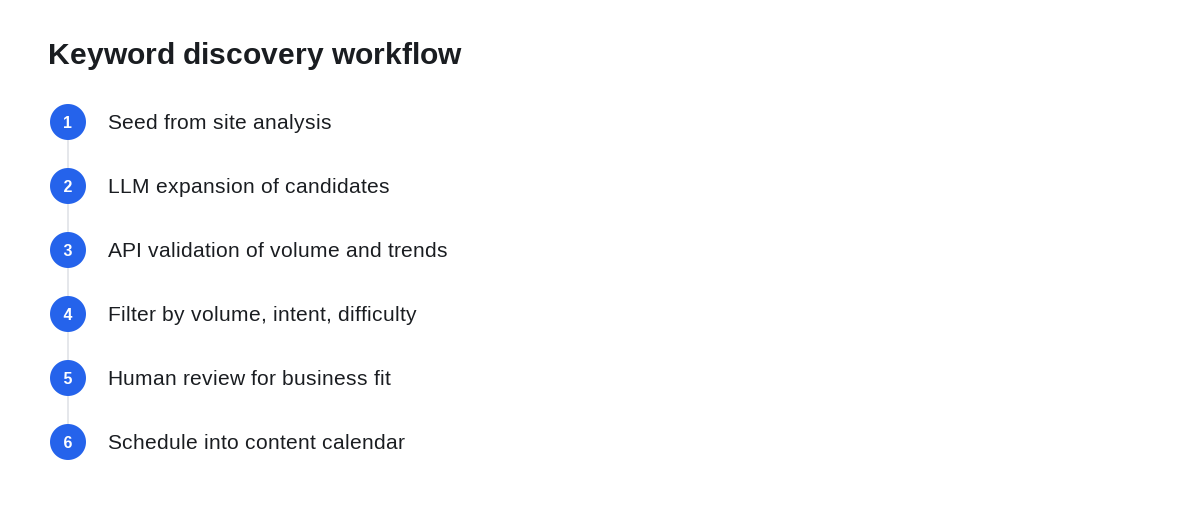
- Seed from site analysis: products, categories, existing pages.
- LLM expansion: candidates and phrasing variants.
- API validation: volume, trend, CPC, competition for every candidate.
- Filter by minimum volume, intent fit, and difficulty.
- Human review: check relevance and business fit.
- Schedule into a content calendar.
- Re-check with your own performance data over time.
Keep the LLM out of the numbers: it proposes and classifies, the API supplies the metrics.
Evaluation checklist for any keyword data source
| Question | Why it matters |
|---|---|
| Location and language coverage | Volume differs by market; confirm your target is supported |
| Freshness | Check last-updated fields on returned data |
| How volume is sourced | Google Ads, Bing, clickstream, or blends change interpretation |
| Cost per keyword | Optional parameters can change price; the vendor notes clickstream data doubles the request price for Labs endpoints |
| Batch size and rate limits | Determines how big a pipeline run can be |
| Documentation quality | Needed for reliable automation |
| Trend/history access | Separates seasonal spikes from steady demand |
Verify current pricing and limits in the vendor's official documentation before building, since the sources here are dated.
When a simple setup is enough
If you target a handful of topics a quarter, a standard keyword tool or a small script that sends your list to one endpoint and writes a spreadsheet is plenty. Automating the full pipeline starts to matter when you publish weekly, manage several sites, or need validation to happen without someone babysitting spreadsheets.
One option that applies this pattern
If you'd rather not build the pipeline yourself, PilotScribe describes a similar approach: it reads your site, uses real Google search data filtered to buyer-intent terms (a company claim), and schedules articles with a review window before anything goes live. Its privacy policy lists SEO data providers for search volume and keyword data among its subprocessors; it does not state in the sources reviewed here which provider is used for any given feature. Evaluate it against the checklist above like any other source.
Caveats
- Search volume measures classic search queries. Whether and how brands appear in AI-generated answers is a separate question that needs different tracking.
- Volume is one input. Your own Search Console data, once you have it, is better evidence of what works for your site.
- Low volume isn't always worthless (specific, high-intent long-tail terms can matter), so set thresholds deliberately instead of by reflex.
FAQ
Can I just ask an LLM for search volume? No. It has no measured demand behind it. Use it for ideas and grouping, and an API for numbers.
Is API search volume exact? No. It's an estimate that varies by source, location, and freshness, and Google's underlying data is itself rounded or grouped, as DataForSEO describes.
How many keywords can I validate at once? The documented Keyword Overview endpoint accepts up to 700 per request, per the help center.