
An AI content idea generator is a tool that uses artificial intelligence to produce relevant and engaging topic suggestions based on your keywords or prompts. It helps marketers overcome writer's block and discover what their audience is searching for, saving hours of manual research and guesswork.
Why Use an AI for Content Ideation?
Manually brainstorming content ideas is a slow process limited by your own perspective. An AI-powered topic tool shatters these limits by analyzing vast datasets of search trends, competitor articles, and forum discussions to find angles you would otherwise miss.
Key benefits include:
- Uncovering Audience Needs: Suggestions are based on real search queries, ensuring you create content people are actively seeking.
- Saving Strategic Time: Condense hours of research into seconds, freeing your team to focus on creation and promotion.
- Achieving Topic Variety: Discover niche sub-topics and fresh perspectives within broad subjects to stand out in a crowded SERP.
- Boosting SEO: Many tools specifically suggest long-tail keywords and questions that are easier to rank for and attract high-intent traffic.
The Best AI Content Idea Generators of 2026
Many tools promise endless ideas, but their quality varies dramatically. Some provide generic, uninspired headlines, while others offer strategic angles grounded in search data. Based on an analysis of the market, these are the tools that consistently deliver high-quality, actionable ideas.
1. HubSpot's Blog Ideas Generator
HubSpot's tool is a classic for a reason. It's incredibly simple and focuses on one thing: generating blog post titles. You can enter up to five nouns, and it will produce a week's worth of content ideas instantly. To unlock more, you need to provide your contact information.
- Best For: Marketers looking for quick, classic blog headlines and titles to jumpstart a draft.
- Output Quality: The ideas often follow proven formulas (listicles, how-to guides). For the prompt "SaaS marketing," it might suggest titles like "SaaS Marketing: The Ultimate Guide" or "10 SaaS Marketing Mistakes to Avoid."
2. Copy.ai's Content Idea Generator
As part of a larger AI writing suite, Copy.ai's tool is more versatile. It can generate ideas for various formats, including blog posts, social media updates, and video scripts. It allows for more descriptive input, leading to more tailored and creative outputs.
- Best For: Content teams needing diverse ideas across multiple channels, not just blogs.
- Output Quality: Tends to be more creative and angle-focused. Given the same "SaaS marketing" prompt, it might generate more nuanced ideas like "How to Use Product-Led Growth in Your SaaS Marketing Funnel" or "Creating a Viral Launch Campaign for Your New SaaS Feature."
3. Hootsuite's Content Ideas Tool
Designed with social media managers in mind, Hootsuite's generator excels at creating ideas for platforms like Instagram, TikTok, and Facebook. It asks for nouns and a primary keyword, then suggests posts tailored to social engagement.
- Best For: Social media managers who need a constant stream of post ideas.
- Output Quality: The suggestions are inherently social-first. For a prompt about "sustainable fashion," it might suggest a TikTok video concept like "3 Fast Fashion 'Facts' That Are Actually Myths" or an Instagram carousel idea like "A 5-Slide Guide to Building Your First Sustainable Wardrobe."
4. Ahrefs' Free Keyword Generator
While not strictly an "idea generator," Ahrefs' tool is essential for SEO-driven content. You enter a seed keyword, and it returns hundreds of related keywords and questions people are searching for, along with their monthly search volume and difficulty score. It turns raw data into content opportunities.
- Best For: SEO professionals and content strategists who need to ground every idea in hard search metrics.
- Output Quality: The output is a list of keywords, not headlines. It's your job to frame them. For "cold brew coffee," it might show you the question "how long does cold brew coffee last," which is a perfect idea for a high-intent blog post.
Tool Comparison Summary
| Tool | Primary Focus | Output Style | Data Integration | Best For |
|---|---|---|---|---|
| HubSpot | Blog Titles | Formulaic Headlines | None | Quick blog brainstorming |
| Copy.ai | Multi-format Ideas | Creative Angles | None | All-purpose content teams |
| Hootsuite | Social Media Posts | Engaging Social Concepts | None | Social media managers |
| Ahrefs | Keyword Opportunities | Raw Search Queries | Search Volume & Difficulty | SEO-driven strategy |
How to Write Prompts That Generate Great Ideas
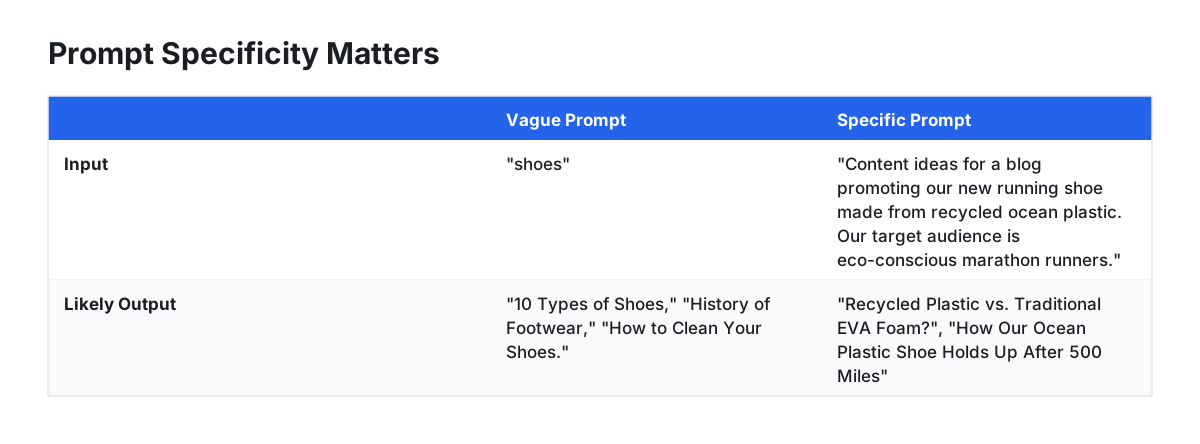
The quality of the ideas you get depends entirely on the quality of your input. Vague prompts lead to generic ideas. Specific, context-rich prompts lead to unique, actionable ones.
Let's compare outputs for a fictional sustainable shoe brand:
Vague Prompt:
"shoes"Likely Output: "10 Types of Shoes," "History of Footwear," "How to Clean Your Shoes." (Too broad to be useful).
Specific Prompt:
"Content ideas for a blog promoting our new running shoe made from recycled ocean plastic. Our target audience is eco-conscious marathon runners."Likely Output: "Recycled Plastic vs. Traditional EVA Foam: What's a Better Running Midsole?", "How Our Ocean Plastic Shoe Holds Up After 500 Miles: A Performance Review," "The Ultimate Guide to Sustainable Marathon Training Gear."
The second set of ideas is specific, targeted, and directly supports the business goal.
How to Generate Ideas for Social Media (TikTok & Instagram)
Brainstorming for visual-first platforms requires a different approach. Your prompts should specify the format and the platform's style.
- For TikTok/Instagram Reels: Use prompts like "Generate 5 TikTok video ideas about [topic]" or "Short video script comparing [product A] and [product B]." The AI will focus on hooks, quick cuts, and trending audio concepts.
- For Instagram Carousels: Use prompts like "Create a 5-slide Instagram carousel post explaining [complex topic]." This encourages the AI to break down information into digestible, swipeable slides.
For example, asking for "Instagram Reel ideas for our coffee shop" might yield suggestions like: "A satisfying POV video of making our signature latte," "A quick 'before and after' of our morning bakery delivery," or "A time-lapse of a busy Saturday at the cafe."
The Limitation: Turning a Great Idea into a High-Ranking Article

An idea generator solves the first problem, but it leaves you facing a mountain of work. A validated topic is only 5% of the battle. The real challenge is the execution, which involves a multi-stage, manual workflow:
- Keyword Validation & SERP Analysis: You must confirm your idea has sufficient search volume and understand the intent behind the top-ranking pages. What format are they? How long are they? What sub-topics do they cover?
- Outlining: You need to structure a comprehensive, SEO-friendly outline that covers the topic better than the current top 10 results.
- Drafting & Editing: This is the most time-consuming part—writing thousands of words of accurate, engaging, and original content, then polishing it to perfection.
- On-Page SEO & Publishing: You have to optimize meta titles, descriptions, images, and internal links, then format everything correctly in your CMS.
- Performance Monitoring & Updating: After all that work, you must track the article's performance on Google. If it underperforms, it needs to be analyzed and improved—a step most teams skip.
This is where full automation platforms provide a decisive advantage. Instead of just giving you an idea, they manage the entire lifecycle. A tool like PilotScribe automates this whole process. It analyzes your business to find buyer-intent keywords, writes the complete long-form articles, and publishes them directly to your site. Crucially, PilotScribe automatically monitors how each article ranks on Google and improves the ones that underperform, creating a true content engine for your business.
If you want to go from idea to traffic without the manual work in between, discover the fully automated workflow with PilotScribe.
FAQ
What are some good AI content ideas?
For a niche like 'sustainable fashion,' a good AI would generate specific, engaging ideas like: 'Beyond Organic Cotton: 5 Innovative Eco-Friendly Fabrics You Need to Know About,' 'How to Build a Capsule Wardrobe with Secondhand Pieces,' 'A Deep Dive into the True Cost of Fast Fashion,' or 'DIY Repair Guide: Making Your Favorite Denim Last a Decade.'
How do I create my own AI content?
You create AI content by first using an idea generator to find a strong, data-backed topic. Then, you use an AI writer to produce a first draft. The critical next step is to heavily edit, fact-check, and enrich the draft with your unique expertise, examples, and brand voice before optimizing for SEO and publishing.
Can you give me 10 content ideas?
Certainly. Here are 10 versatile content ideas you can adapt for any industry:
- The Ultimate Beginner's Guide to [Your Core Topic].
- [Number] Common Mistakes People Make When [Performing a Task] and How to Fix Them.
- [Tool/Strategy A] vs. [Tool/Strategy B]: An Unbiased Comparison.
- A Step-by-Step Checklist for [Achieving a Key Goal].
- How We Solved [A Common Customer Problem] (Case Study).
- The Top [Number] Industry Trends to Watch in 2026.
- An In-Depth Review of [A Popular Product or Service].
- How to Calculate the ROI of [Your Service Category].
- Debunking [Number] Common Myths About [Your Industry].
- Answering the Top [Number] Questions We Get About [Your Topic].
Can I create an AI content generator?
While it is technically possible for a developer to build a basic AI idea generator using an API from a large language model (LLM), it is a complex undertaking. For most businesses and marketers, using established, specialized tools is far more efficient and effective, as these tools have been refined for usability and output quality.